
E-commerce SEO Services
E-commerce SEO Services for Catalogues Built to Be Found
Our e-commerce SEO services help online shops get category and product pages found by people ready to buy, on Google and in AI answers that recommend products. Senior SEOs start with how search engines crawl your catalogue, then improve the pages that take orders and report on the sales they bring.
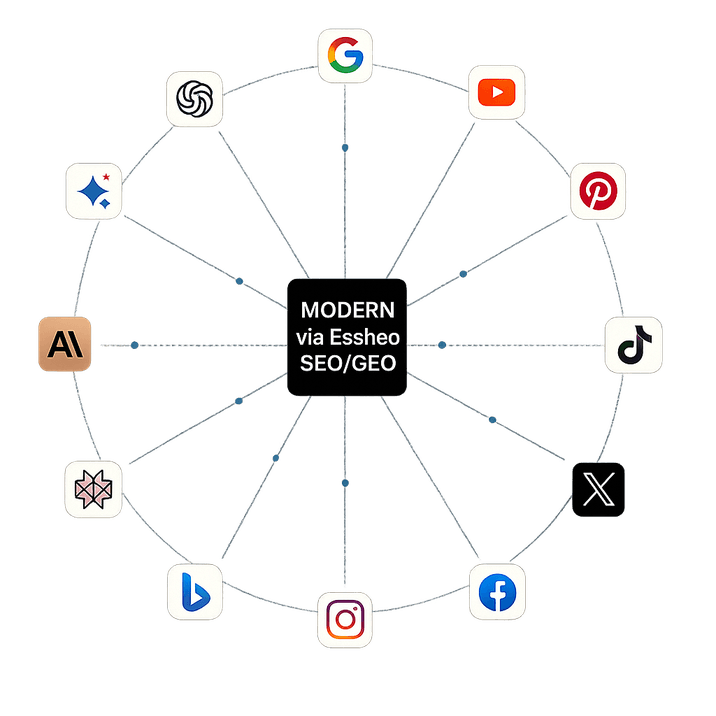
- Search platforms optimised, from Google to ChatGPT, Perplexity, Reddit and YouTube
- 24
Some of the brands we have worked with





Who this is for
Signs your shop has outgrown basic SEO
Filters multiply your URLs
Every filter combination and product variant can create another near-copy of a page. Search engines then spend crawl on low-value URLs, and the category and product pages that sell get less attention.
Category pages are bare grids
Your category pages are a heading above a product grid, with no copy of their own. Thin category descriptions hold rankings down, however strong the content or links elsewhere on the site.
A redesign will move your URLs
A new design, a new platform or a tidy-up of messy URLs changes category and product page addresses. Unless each redirects to a planned match, rankings built over years can disappear in a week.
Searches with no page to match
Shoppers search for a kind of product you already sell, yet no collection page groups those items together. With no high-intent landing page built around that search, that demand goes untapped.
What we do
Why a catalogue changes the SEO work
E-commerce SEO services work at the scale of a catalogue: potentially thousands of product and category pages, with filters and variants adding near-copies. Search engines only crawl so much of a site, so duplicates take attention from the pages taking orders.
Category pages can take high-volume, high-intent searches; product pages need descriptions of their own to give each a reason to rank.
Value Doors showed how far duplication goes: a 20-year-old site of 20,000 pages, many repeating one product with, say, a black handle instead of a white one. After a 301 redirect map, Myles, our founder, restructured the URLs and culled the near-copies. The aim was a site Google could crawl more easily, with no two pages competing for the same searches.
What our e-commerce SEO services include
E-commerce SEO audit
A crawl for indexation, duplicate and faceted URLs, redirect chains and wasted crawl budget, plus a review of category, product and guide pages.
Keyword map by intent
Branded, informational, commercial and transactional searches mapped against your catalogue and competitors' rankings, with gaps flagged for new collection pages.
Category and product copy
Unique copy for category and subcategory pages, rewrites of thin or duplicated product descriptions, and titles, headings and URLs set by page type.
Schema and internal links
Product, Offer and Review schema so results can show price, availability and star ratings, plus links between related products and categories.
Links earned through PR
Digital PR and journalist outreach to sites in your niche, as with UK Composite Doors' topically relevant links. Nothing bought from networks, whose footprints Google's spam systems catch.
Shopify stores also get platform fixes through Shopify SEO, and replatforms are planned through Technical SEO, both within our SEO Services.
Product data that AI answers can use
Comparison and specification questions drive many purchases, and AI Overviews and assistants such as ChatGPT now answer them. Marked-up product data improves your chances of appearing. Pages that settle the comparison help too, as do mentions on review sites and community forums that models draw on. Our Generative Engine Optimisation work covers all three.
For Hay Day, which sells hay for small pets through Shopify, our plan grouped the core collections by hay type. FAQs such as "What hay is best for rabbits?" and comparison-style content sat alongside, so AI assistants could include its hay when suggesting what to buy.
How we measure e-commerce SEO
Reports start from sales, not sessions: organic revenue and conversion rate from Google Analytics 4 and your platform's own analytics. Search Console covers indexing and search queries, rank tracking follows your commercial terms, and AI visibility sits alongside.
How it works
How an e-commerce SEO campaign runs
Most shops see rankings and organic traffic move within three to six months; quick technical fixes can show sooner.
Related services
Other SEO services
Expert Local SEO Agency
A local SEO agency works to put your business in front of nearby people searching for what you do: in Google's map pack, the organic results beneath it and AI assistants' recommendations.
International SEO Services
We are an international SEO agency for businesses selling in more than one country, helping buyers in each market reach the version of your site built for them.
Link Building
Authority is still the hardest ranking factor to fake and the one that separates page one from page three in competitive sectors.
On-Page SEO Services
Our on-page SEO services tune each page for the searches it should win, through the title, headings, copy, internal links and images search engines read, with the copy checked for how an AI assistant would read it.
SEO Services
Every account at Essheo is worked by a senior SEO, not handed down to a junior after the pitch.
Shopify SEO Services
As a Shopify SEO agency, we help stores get their collections and products found, whether shoppers search Google or ask an AI assistant.
Insights
E-commerce SEO Guides
How Does E-Commerce SEO Support Retention And Repeat Purchases?
E-commerce SEO Guides
How Does E-Commerce SEO Influence The Entire Online Buying Journey?
E-commerce SEO Guides

How Do You Build A Sustainable E-Commerce Marketing Strategy?
E-commerce SEO Guides
How Does SEO Reduce Customer Acquisition Costs For E-Commerce Stores?
E-commerce SEO Guides
What E-commerce Executives Should Know About Organic Search
E-commerce SEO Guides

Why E-commerce Businesses Lose Market Share Without SEO
E-commerce SEO Guides
FAQs
Frequently Asked Questions
As a clear hierarchy of categories, subcategories and products, with internal links so no page is orphaned. Filter URLs need canonical or robots rules so they do not compete with their category page; near-copy variants should fold into their product page for the same reason.
Start with what holds the whole catalogue back: duplicate variants, wasted crawl and slow, image-heavy templates. Then improve the pages that take orders, from category copy to product descriptions, schema and internal links, judging each change by sales, not visits.
Sales first: organic revenue and conversion rate, split so you can see which categories and products earn most. Then how much of the catalogue is indexed, rankings for the terms you sell on and AI visibility, with written commentary rather than charts alone.
None wins by default. Each handles URLs, metadata and product structure its own way, so we tailor the work to yours. Complexity has a cost too: Easy Boilers, a headless React site we built for speed, was exceptionally fast but expensive to build and maintain.
Because people searching for a type of product, or a specific one, are close to buying, and category and product pages answer those searches. In e-commerce, retailers with seven-figure budgets hold the top results, so a smaller shop needs pages that each have a reason to rank.
Reputable agencies show published work on online shops, name who runs your account and explain how they report. Our e-commerce SEO services are run by SEOs with 8+ years' experience each; our published shop work includes UK Composite Doors and Hay Day. Nobody controls Google, so nobody can promise rankings.
Speak to us today to get started