Search Marketing
From Google to “Search Everywhere”: How Search Marketing Has Fundamentally Changed
For over two decades, search marketing was largely synonymous with one platform: Google. Brands competed for visibility through rankings, keywords, and backlinks, all within a relatively predictable ecosystem of “10 blue links.”
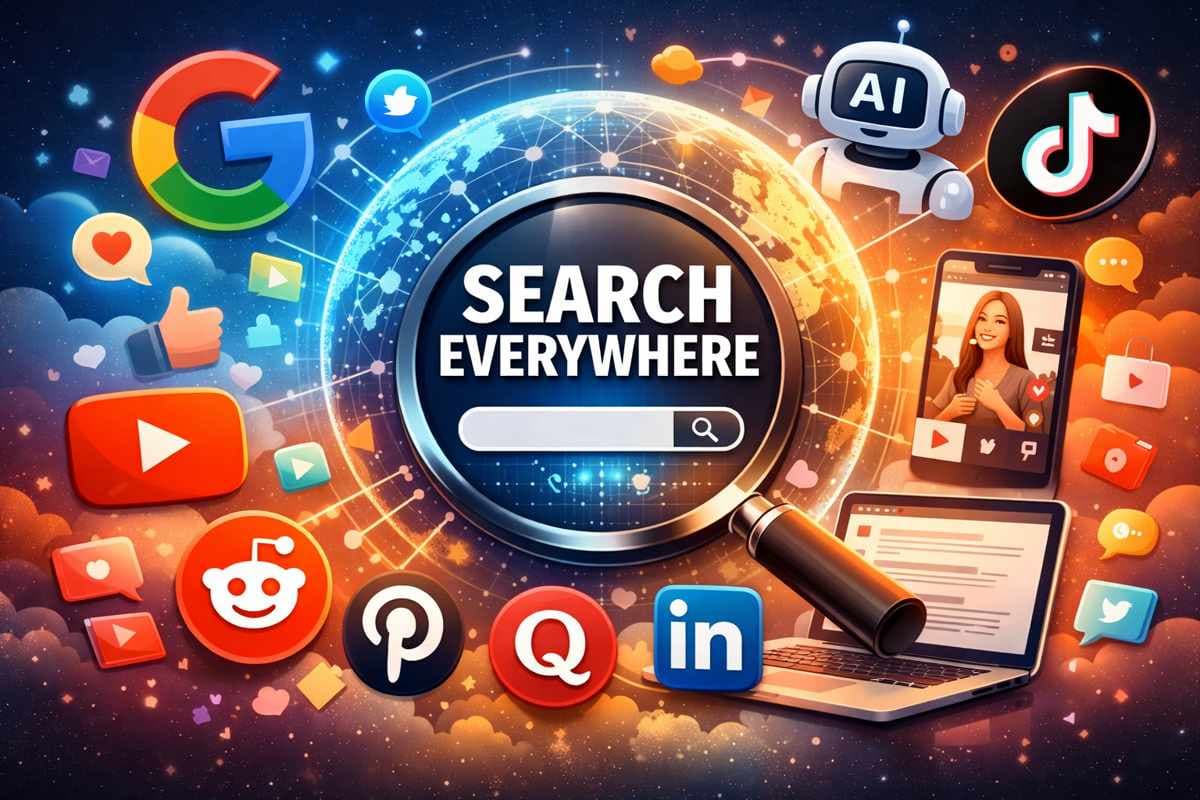
Today, that world has fractured. Search is no longer a single destination. It’s a behaviour that happens across AI tools, social platforms, communities, and content ecosystems. What was once Search Engine Optimisation (SEO) has evolved into something much broader: Search Everywhere Optimisation.
This shift is being driven by three major forces: AI-powered search, changing user behaviour, and the rise of alternative discovery platforms.
1. The Old World: Google Dominance
Historically, search marketing was built around Google’s algorithm. Success depended on:
- Ranking highly for keywords
- Building backlinks
- Optimising on-page SEO
- Driving clicks from SERPs
Traffic was the primary KPI, and the model was simple:
Search → Click → Website → Conversion
For years, this system worked at scale. But cracks have started to appear.
Speak to us today to get started.
Book a Call2. The Rise of AI Search and “Zero-Click” Behaviour
The biggest disruption has come from AI.
Google’s AI Overviews and tools like ChatGPT, Perplexity, and Gemini have transformed search into an answer-first experience rather than a click-first one. Instead of showing links, platforms now generate direct responses.
- Around 60% of searches now end without a click
- AI-generated summaries increasingly sit above organic results
- LLMs aggregate multiple sources into a single answer
This fundamentally changes the game:
- Users get what they need instantly
- Websites lose traffic (even if they’re the source)
- Visibility matters more than clicks
In short:
Ranking #1 no longer guarantees traffic, or even attention.
3. From Search Engines to Answer Engines
Large Language Models (LLMs) have introduced a new layer to search:
- ChatGPT
- Perplexity
- Claude
- Google Gemini
These platforms don’t just retrieve information: they synthesize it.
This has led to a new discipline:
👉 Generative Engine Optimisation (GEO)
Instead of optimising for rankings, brands now need to optimise for:
- Being cited in AI answers
- Structured, machine-readable content
- Authority and trust signals (E-E-A-T)
4. The Explosion of “Search Everywhere”
At the same time, user behaviour has shifted dramatically.
Search is no longer confined to Google. People now discover information across multiple platforms:
Social Platforms as Search Engines
- TikTok (especially for Gen Z discovery)
- YouTube (how-to, reviews, education)
- Pinterest (visual discovery)
- LinkedIn (B2B insights)
Community-Led Search
- Quora
- Forums
These platforms provide real human experiences, which users trust more than polished content.
Do you want to be seen across the exact platforms that your ideal customers are on?
Book a Call5. Trust Has Shifted: From Brands to Communities
Another major change is how people evaluate information.
In the past:
- Brands controlled messaging
- Websites were the source of authority
Today:
- Users trust peer reviews and discussions
- Authenticity beats polish
- Community validation influences decisions
This shift also feeds into AI: LLMs often pull from these same community-driven sources.
6. The Decline of Traditional SEO Tactics
Classic SEO tactics alone are no longer enough:
- Keyword stuffing → ineffective
- Backlink volume → less impactful
- Ranking alone → insufficient
Instead, modern search success depends on:
- Intent-driven content
- First-hand experience (E-E-A-T)
- Multi-format content (text, video, UGC)
- Cross-platform presence
7. The New Model: Multi-Platform Visibility
The customer journey is now fragmented across platforms:
Example journey today:
- Discover on TikTok
- Validate on Reddit
- Watch on YouTube
- Ask ChatGPT
- Search Google (maybe)
This means brands must show up everywhere, not just in Google rankings.
Modern search strategy includes:
- YouTube SEO
- TikTok content optimisation
- Reddit engagement
- AI citation optimisation
- Traditional SEO (still important, but not enough)
8. The Emergence of “Search Everywhere Optimisation”
The industry is moving toward a new framework:
Search Everywhere Optimisation (SEO 2.0)
Instead of focusing purely on Google, brands must optimise for:
- Search engines (Google, Bing)
- AI platforms (ChatGPT, Perplexity)
- Social discovery (TikTok, YouTube, Pinterest)
- Communities (Reddit, forums)
Because today:
👉 Search is not a platform. It’s a behaviour.
9. What This Means for Marketers
To succeed in this new landscape, marketers need to rethink strategy:
1. Diversify traffic sources
Relying on Google alone is risky. An email list reduces that risk, giving you an audience you own whatever Google does next.
2. Create multi-format content
Text, video, short-form, and community content all matter.
3. Build authority, not just rankings
AI rewards trust, expertise, and citations.
4. Engage in communities
Reddit and forums are now critical touchpoints.
5. Optimise for AI visibility
Structure content so LLMs can understand and cite it.
Conclusion
Search marketing hasn’t disappeared. It has expanded.
What was once a Google-centric discipline has become a complex, multi-platform ecosystem shaped by AI, social media, and user behaviour.
The brands that win today are not those who rank highest…
…but those who are visible everywhere people search, ask, watch, and learn.
Want to talk through how this applies to your business? Book a call with our team.
Book a Call